
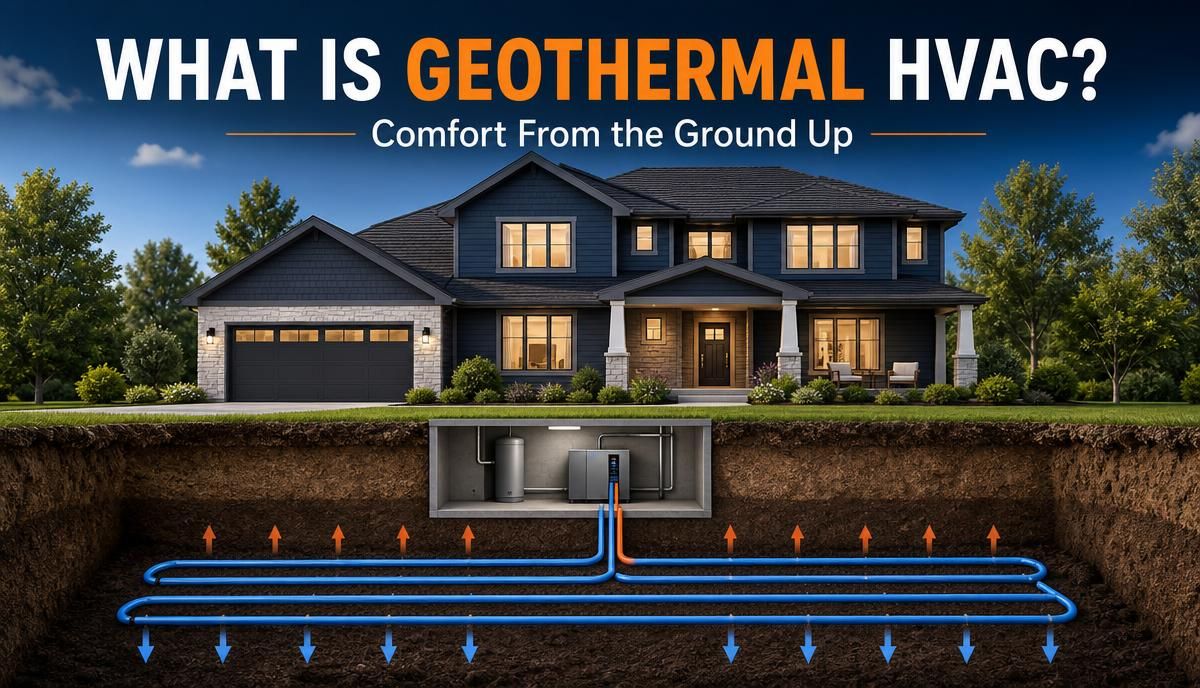
There is a surprisingly powerful heating and cooling resource beneath your home: the ground.
Geothermal heating and cooling uses the relatively stable temperature underground to help heat your home in winter and cool it in summer. A geothermal HVAC system — also called a ground-source heat pump — moves heat between your home and the earth using an indoor heat pump and underground piping called a ground loop.
For the right property, geothermal can provide efficient year-round comfort. But installation is more involved than replacing a traditional HVAC system, which means it is not automatically the best choice for every homeowner.
In this guide, North Star Heating and AC explains how geothermal works, what installation involves, and the questions to consider before deciding whether it is right for your home.
Geothermal HVAC at a Glance
- Provides both heating and cooling
- Uses underground temperatures for heat exchange
- Uses a geothermal or ground-source heat pump
- Requires an underground ground-loop system
- Can work with forced-air ductwork in many homes
- Can be installed in new or existing homes
- Usually requires a larger initial project than a standard HVAC replacement
- Can provide an efficient long-term comfort solution for suitable properties
What Is Geothermal Heating and Cooling?
Geothermal HVAC is a heating and cooling system that uses a ground-source heat pump and buried piping to exchange heat between a building and the earth.
In other words, a geothermal system is a type of heat-pump system that exchanges heat with the earth rather than relying primarily on the outdoor air. It is often called a geothermal heat pump or ground-source heat pump.
A geothermal HVAC system typically includes:
- A geothermal heat pump inside the home
- Underground piping known as a ground loop
- Fluid circulating through the underground loop
- A blower or other distribution equipment
- Ductwork or another compatible distribution system
- Thermostat and system controls
The basic principle is simple: instead of creating heat from scratch, the system moves heat from one place to another. In the winter, it brings heat from the ground into the home. In the summer, it removes heat from the home and transfers it into the ground. That is the same core idea behind the air-source heat-pump options many Delmarva homes already use — geothermal simply swaps the outdoor air for the earth.
How Does a Geothermal System Work?
- Fluid circulates through underground piping.
- The ground loop exchanges heat with the earth.
- A geothermal heat pump transfers that heat into or out of the home.
- The HVAC distribution system delivers heating or cooling indoors.
- The process reverses between heating and cooling seasons.
How Does Geothermal Cooling Work in Summer?
During the cooling season, a geothermal system removes heat from the indoor air. That heat is transferred through the heat pump and into the underground loop.
The ground then acts as the heat-exchange environment. Because underground temperatures are generally more stable than hot summer air temperatures, the system can use the earth as part of the cooling process.
The home is cooled while the heat removed from indoors is transferred into the ground — the same comfort result as conventional air-conditioning services, achieved a different way.
How Does Geothermal Heating Work in Winter?
During colder weather, the process reverses. The geothermal system absorbs available heat from the ground and transfers that heat into the home.
Even when outdoor air becomes very cold, temperatures underground remain far more stable. The geothermal heat pump concentrates and transfers this heat for use inside the home.
This allows one geothermal system to provide both heating and cooling, which is worth keeping in mind if you are comparing whole-home heating services and replacement options.
Why Doesn't Geothermal Need a Traditional Outdoor AC Unit?
Traditional central air conditioners and many air-source heat pumps exchange heat with outdoor air through an outdoor condensing unit.
A geothermal system instead uses buried piping to exchange heat with the ground. That means the property generally does not require the same type of traditional outdoor condenser used by conventional systems.
The main mechanical geothermal equipment is typically located indoors.
What Is a Geothermal Ground Loop?
A ground loop is the buried piping that allows the system to exchange heat with the earth. Fluid circulates through the piping and transfers heat between the ground and the geothermal heat pump.
There are different ways to install ground loops depending on the property.
Horizontal Geothermal Loops
Horizontal loops are installed in trenches across an available area of the property. They can be a practical option when sufficient open land is available.
Vertical Geothermal Loops
Vertical systems use deeper boreholes rather than spreading the loop across a large horizontal area. This can be useful on properties where surface area is more limited.
Other Loop Configurations
Other configurations may be possible depending on:
- Property size
- Ground conditions
- Available land
- Home heating and cooling requirements
- Local requirements
- Installation design
There is no universal geothermal loop design that works for every home.
What Are the Potential Advantages of Geothermal HVAC?
Geothermal has several characteristics that make it attractive to some homeowners.
One System for Heating and Cooling
A geothermal heat pump can provide both heating and air conditioning.
Efficient Heat Transfer
Because the system exchanges heat with relatively stable underground temperatures, geothermal can operate efficiently across changing seasons.
Quiet Outdoor Environment
Because a conventional outdoor condensing unit is generally not required, geothermal can reduce the amount of outdoor HVAC equipment and related outdoor operating noise.
Underground Components Are Protected
The ground-loop portion of the system is buried and is not exposed to the same rain, snow, debris, salt air, or weather conditions as outdoor mechanical equipment — something coastal homeowners often ask about.
Long-Term Comfort Strategy
For homeowners who plan to remain in their property for many years, geothermal may be worth evaluating as a long-term heating and cooling investment.
What Are the Drawbacks of Geothermal?
Geothermal is not the right answer everywhere, and an honest evaluation should include the tradeoffs.
Potential considerations include:
- Higher upfront installation cost
- Excavation or drilling requirements
- Property suitability
- More extensive project planning
- Ground-loop installation
- Existing ductwork may require modifications
- Installation may be more complicated than a conventional HVAC replacement
Geothermal can be an excellent solution in the right application, but it is not automatically the best choice for every homeowner.
How Much Property Do You Need for Geothermal?
There is no single answer. The amount of property required depends partly on the ground-loop design.
Horizontal loop systems typically require more open land. Vertical loop systems can reduce the amount of surface area required by extending deeper underground.
An HVAC/geothermal professional needs to evaluate:
- The property
- Home heating and cooling requirements
- Ground conditions
- Available installation area
- Access
- Appropriate loop configuration
Can Geothermal Be Installed in an Existing Home?
Yes. Geothermal is not limited to new construction, and an existing home can potentially be converted to geothermal heating and cooling.
However, the project needs to account for:
- Ground-loop placement
- Existing ductwork
- Indoor equipment location
- Electrical requirements
- Home heating and cooling load
- Access for installation
- Existing HVAC equipment
In some homes, ductwork modifications may be necessary.
Is Geothermal Good for New Construction?
New construction can be an excellent time to evaluate geothermal because the system can be considered while the home and property are still being planned.
This can allow contractors to coordinate:
- Ground-loop installation
- Indoor equipment placement
- Ductwork
- Electrical requirements
- Mechanical-room layout
- Home comfort design
North Star also handles HVAC design and installation for new homes. If you are planning a build, our full range of HVAC services is a good starting point for that conversation.
Does Geothermal Work With Existing Ductwork?
In many cases, geothermal systems can use forced-air ductwork. But existing ductwork needs to be evaluated.
Factors include:
- Duct sizing
- Airflow
- Leakage
- Supply and return configuration
- Overall condition
- Home comfort requirements
Not every existing duct system can automatically be reused, which is why a duct and vent evaluation is part of planning a conversion.
Is Geothermal Good for Delaware and the Eastern Shore?
Geothermal can be considered for homes throughout Delaware and Maryland's Eastern Shore.
Homeowners across Sussex County, Delaware and the surrounding Delmarva service areas experience both hot, humid summers and cold winter weather, so a system that can provide heating and cooling from one heat pump may be worth exploring.
However, climate is only one factor. Property conditions, installation requirements, home design, existing systems, budget, and long-term plans should all be considered.
How Much Does Geothermal Cost?
Geothermal installations typically have a higher upfront project cost than many conventional HVAC replacements because the installation includes the underground ground-loop system in addition to the mechanical equipment.
Homeowners should evaluate geothermal based on:
- Initial installation cost
- Expected operating costs
- Property suitability
- Existing HVAC equipment
- Length of time they plan to own the home
- Comfort priorities
- Maintenance expectations
- Available incentives, if applicable at the time of installation
Pricing depends on the specific design, so the only accurate number comes from an actual site evaluation. Homeowners comparing larger projects sometimes also review HVAC financing options.
Is Geothermal Worth It?
Geothermal can be worth considering for homeowners who have a suitable property, plan to remain in the home long-term, value energy efficiency, and are comfortable with the larger initial installation project. For other homeowners, a high-quality conventional heat pump or another HVAC solution may make more practical sense.
The best answer requires evaluating the specific property: the land available, ground conditions, the home's heating and cooling load, the condition of existing equipment and ductwork, and how long you plan to stay.
How Do You Know if Geothermal Is Right for Your Home?
Geothermal may be worth exploring if:
- You are building a new home
- You are replacing an entire HVAC system
- You expect to remain in the home for many years
- Energy efficiency is a major priority
- You want one system for heating and cooling
- Your property can accommodate a suitable ground-loop installation
- You want to explore alternatives to conventional HVAC systems
Another option may make more sense if:
- The property makes ground-loop installation difficult
- Upfront installation budget is the primary concern
- You plan to move soon
- Your existing system only requires a minor repair
- Site conditions significantly complicate installation
North Star Comfort Tip
Geothermal is not simply an HVAC unit that gets swapped into the same space as your old equipment.
It is a complete heating and cooling system involving the home, mechanical equipment, ground loop, airflow, and property.
That is why a proper site evaluation and system design are especially important.
Does Geothermal Require Maintenance?
Yes. While the underground ground loop generally requires relatively little routine homeowner attention, the mechanical HVAC system still needs maintenance.
Maintenance may include:
- Inspecting the indoor unit
- Checking airflow
- Changing or inspecting filters
- Inspecting electrical components
- Checking condensate drainage
- Checking loop pressure and circulation
- Verifying thermostat operation
- Evaluating overall heating and cooling performance
Routine professional HVAC maintenance helps keep any system operating the way it was designed to.
Quick Answers About Geothermal HVAC
Does geothermal heat and cool a house?
Yes. A geothermal heat pump can provide both heating and cooling by transferring heat between the home and the ground.
Does geothermal work when it is freezing outside?
Yes. Geothermal systems rely primarily on temperatures underground rather than directly exchanging heat with freezing outdoor air.
Does geothermal need ductwork?
Many geothermal systems use conventional forced-air ductwork, although other configurations may exist. Existing ductwork should be evaluated to make sure it can support the system's airflow requirements.
Can you add geothermal to an existing house?
Yes. Geothermal can be installed in an existing home, although the property, ductwork, equipment location, electrical requirements, and ground-loop installation all need to be evaluated.
Is geothermal only for large properties?
No. The required installation area depends partly on the ground-loop design. Horizontal loops generally need more open surface area, while vertical systems use deeper boreholes.
Does geothermal replace both the furnace and air conditioner?
In many applications, a geothermal heat pump becomes the primary system providing both heating and cooling. The exact system design depends on the property and homeowner's needs.
Is geothermal right for every home?
No. Property conditions, cost, available space, existing infrastructure, comfort goals, and long-term ownership plans should all be considered before recommending geothermal.
Is Geothermal Right for Your Home?
Geothermal heating and cooling is an interesting option because it takes advantage of something every property already has beneath it: the earth.
By exchanging heat with relatively stable underground temperatures, a geothermal heat pump can provide both heating and cooling from one system.
For the right homeowner and property, geothermal can be a compelling long-term comfort solution. But the best way to determine whether geothermal makes sense is to evaluate the actual home, property, existing equipment, and comfort goals.
North Star Heating and AC works with geothermal heating and cooling systems throughout the Delmarva region. If you are curious about geothermal, contact North Star to learn more and determine whether it may be a good fit for your home.
Frequently Asked Questions
What is geothermal heating and cooling?
Geothermal heating and cooling uses a ground-source heat pump and underground piping to transfer heat between a home and the earth. The system can provide both heating and air conditioning.
How does geothermal cool a house?
During cooling, the system removes heat from the indoor air and transfers it into the ground through the geothermal loop.
How does geothermal heat a house?
During heating, the system absorbs heat from the ground and transfers it into the home using the geothermal heat pump.
Does geothermal work in Delaware?
Geothermal can be used in Delaware homes, but property conditions, home design, heating and cooling needs, ground-loop requirements, and installation costs should be evaluated before choosing a system.
Can geothermal be installed in an existing house?
Yes. Geothermal can be installed in many existing homes, although ground-loop installation, existing ductwork, mechanical space, electrical requirements, and property access all need to be evaluated.
What is a geothermal ground loop?
A ground loop is buried piping containing circulating fluid that allows the geothermal system to exchange heat with the earth.
Does geothermal need an outdoor AC unit?
A geothermal system generally does not use the same type of traditional outdoor condenser found with conventional central air-conditioning systems because heat exchange occurs through the underground loop.
Is geothermal worth considering?
For homeowners with a suitable property, long-term ownership plans, and an interest in efficient year-round heating and cooling, geothermal can be worth evaluating. It is not automatically the best solution for every home.